 raft
raft"Write it in pythonic style as a pythonista would"
The prompt in the title isn't mine — it comes from Sébastien Vian, CTO of Wisetax, hosted in our coworking space in Marseille. He drops it on LLM-generated Python, and it made me laugh enough to try it the same morning on a real script. The rewrite was nice; the conversation that followed turned out to be the interesting part.
The context: our CRM (Attio) was polluted by an old bulk import, and I wanted a scripted cleanup — a single file, requests as the only dependency, dry run by default, a hard confirmation gate before anything gets deleted.
1. The naive script is a reasonable default
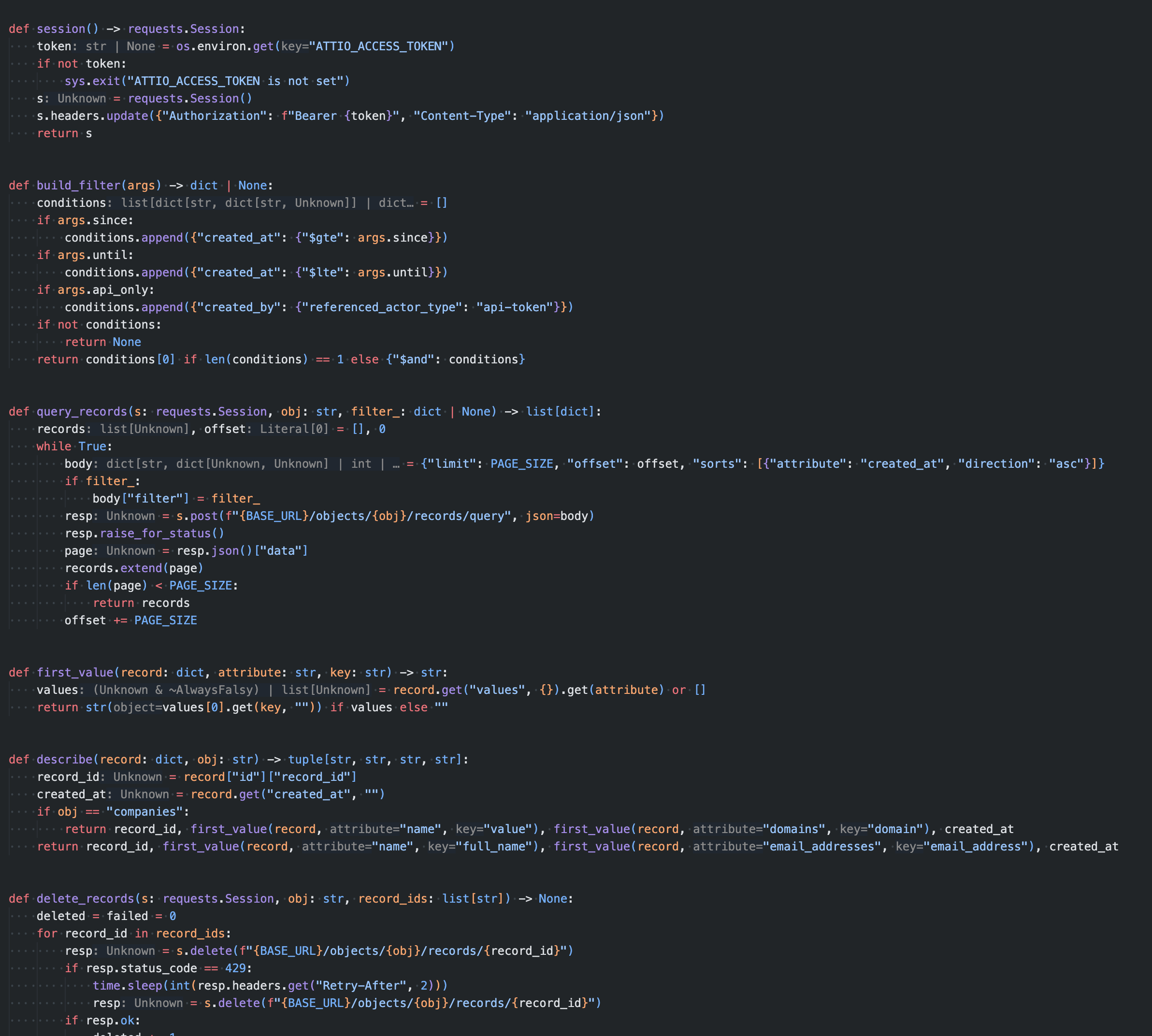
Claude's first version is flat functions and explicit state — no cleverness:
def query_records(s: requests.Session, obj: str, filter_: dict | None) -> list[dict]:
    records, offset = [], 0
    while True:
        body = {"limit": PAGE_SIZE, "offset": offset,
                "sorts": [{"attribute": "created_at", "direction": "asc"}]}
        if filter_:
            body["filter"] = filter_
        resp = s.post(f"{BASE_URL}/objects/{obj}/records/query", json=body)
        resp.raise_for_status()
        page = resp.json()["data"]
        records.extend(page)
        if len(page) < PAGE_SIZE:
            return records
        offset += PAGE_SIZE
Nothing wrong with it. It works, anyone can read it, and the per-object formatting is a plain if obj == "companies" branch. For a script you run twice and delete, that's arguably the right level — and it's what a model produces by default, because it's what the average reader can follow.
2. What "pythonista" changes
One prompt later — the exact quote from the title — same behavior, different shape:
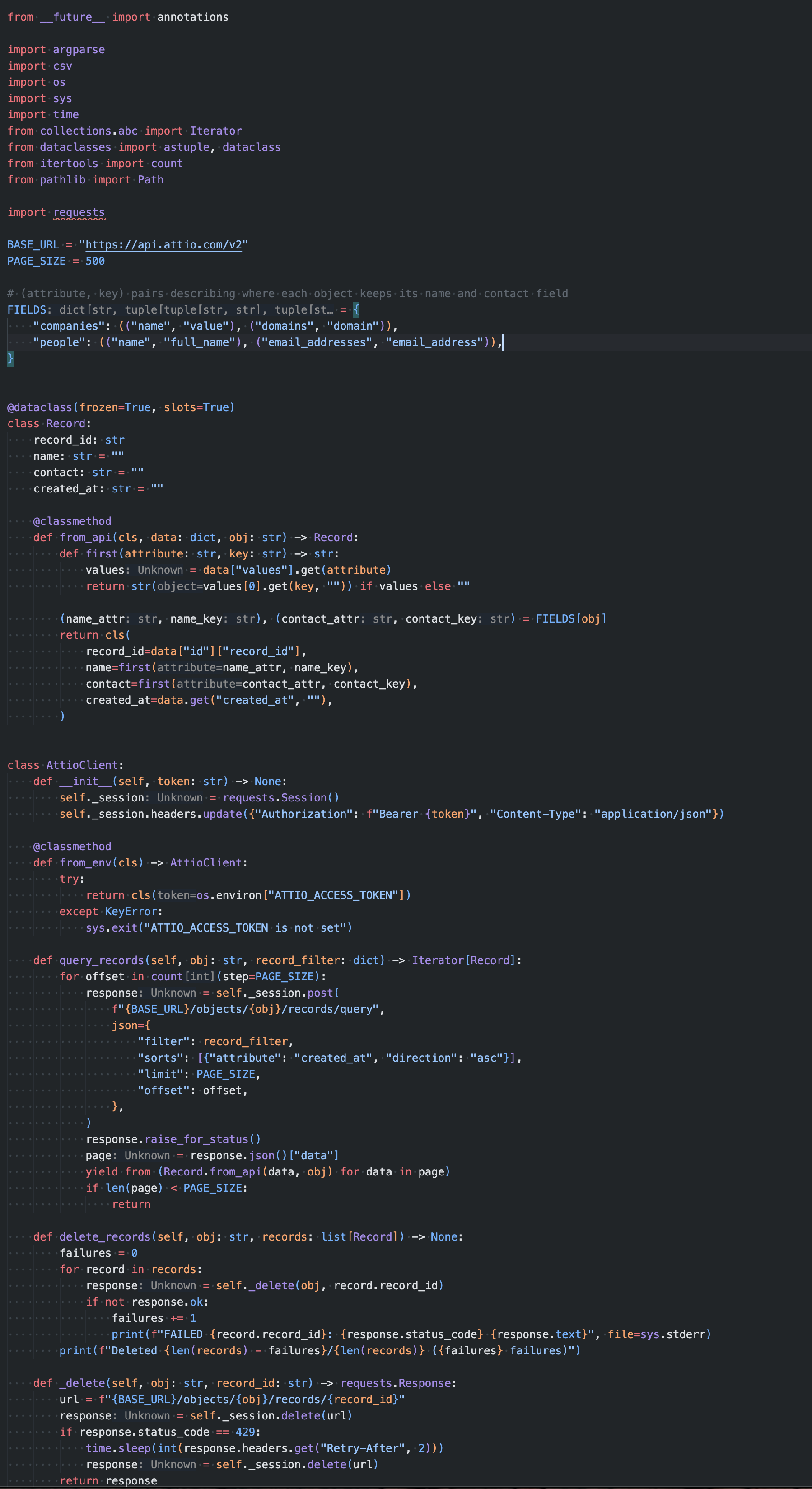
- pagination becomes a generator:
itertools.count(step=PAGE_SIZE)plusyield from, no offset bookkeeping, no list accumulation - records become a frozen dataclass with a
from_apiclassmethod that owns the unwrapping of Attio's{"values": {...}}format - the
if obj == "companies"branching becomes a declarativeFIELDSmapping — which also feeds argparse'schoices, so the valid objects have a single source of truth - a
matchstatement composes the query filter, and the env var is read EAFP-style (os.environ[...]+except KeyError)
FIELDS = {
    "companies": (("name", "value"), ("domains", "domain")),
    "people": (("name", "full_name"), ("email_addresses", "email_address")),
}

def query_records(self, obj: str, record_filter: dict) -> Iterator[Record]:
    for offset in count(step=PAGE_SIZE):
        response = self._session.post(
            f"{BASE_URL}/objects/{obj}/records/query",
            json={"filter": record_filter, "limit": PAGE_SIZE, "offset": offset,
                  "sorts": [{"attribute": "created_at", "direction": "asc"}]},
        )
        response.raise_for_status()
        page = response.json()["data"]
        yield from (Record.from_api(data, obj) for data in page)
        if len(page) < PAGE_SIZE:
            return
3. Make it justify the idioms
The rewrite passed session as an argument to every function:
def query_records(s: requests.Session, obj: str, filter_: dict | None) -> list[dict]: ...
def delete_records(s: requests.Session, obj: str, record_ids: list[str]) -> None: ...
I didn't see why, so I asked the question as-is: "why would you pass session to each method?". Answer: the dependency is visible in the signature, and in a test you hand it a fake session without ever touching the network. The alternatives: a module-level global (shorter, but the dependency becomes invisible), or a class (more structure than 150 lines need).
I still preferred the class version — you read client.query_records(...) and the session becomes an internal detail. Ten lines of refactoring:
class AttioClient:
    def __init__(self, token: str) -> None:
        self._session = requests.Session()
        self._session.headers.update({"Authorization": f"Bearer {token}"})

    @classmethod
    def from_env(cls) -> AttioClient:
        try:
            return cls(os.environ["ATTIO_ACCESS_TOKEN"])
        except KeyError:
            sys.exit("ATTIO_ACCESS_TOKEN is not set")

    def query_records(self, obj: str, record_filter: dict) -> Iterator[Record]:
        ...
Same exercise for cls(), which I rarely use: it's the @classmethod convention, like self, and from_env is an "alternative constructor" — the same naming as datetime.fromtimestamp() in the stdlib.
The model proposes, I question what I wouldn't have written, it lays out the alternatives, I decide.
4. What's still pending
frozen=True, slots=True on a throwaway script is probably too much, and the match over three conditions is taste. The naive version would have cleaned the CRM just fine.
I'll still do it again for scripts I intend to keep — probably not for a true one-shot 😅