 raft
Parallelizing RSpec on GitHub Actions
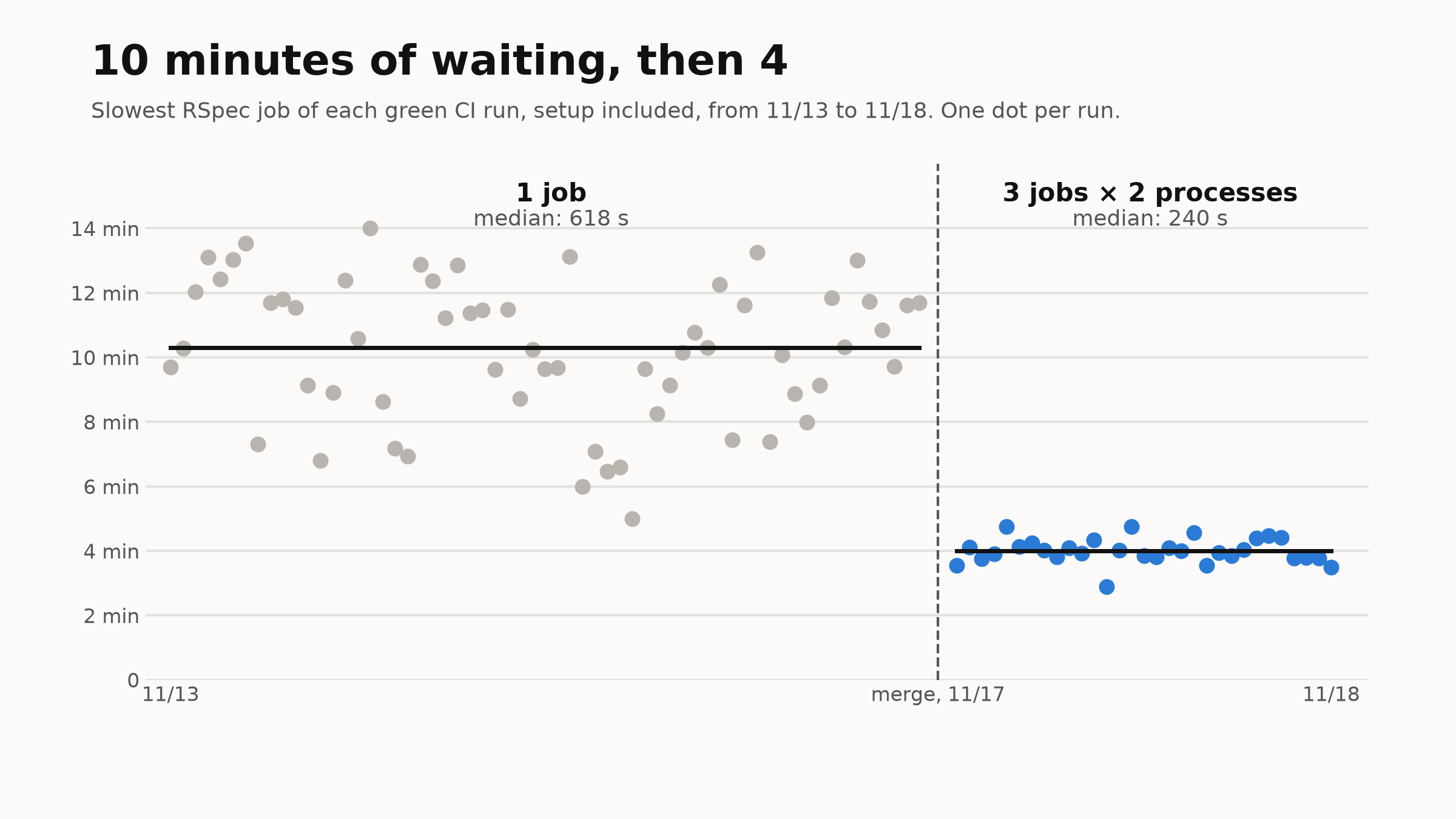
At one of our clients, a PR touching the API took 10 minutes to get through CI. Now it takes less than 5.
In Running only the changed project's tests, we stopped running the tests of the parts of the code a PR doesn't touch. But for a PR touching the API, RSpec still ran in a single job. We split it across several runners: CI does the same work, but in parallel, so we wait less.
Parallelizing: 3 jobs, 6 processes
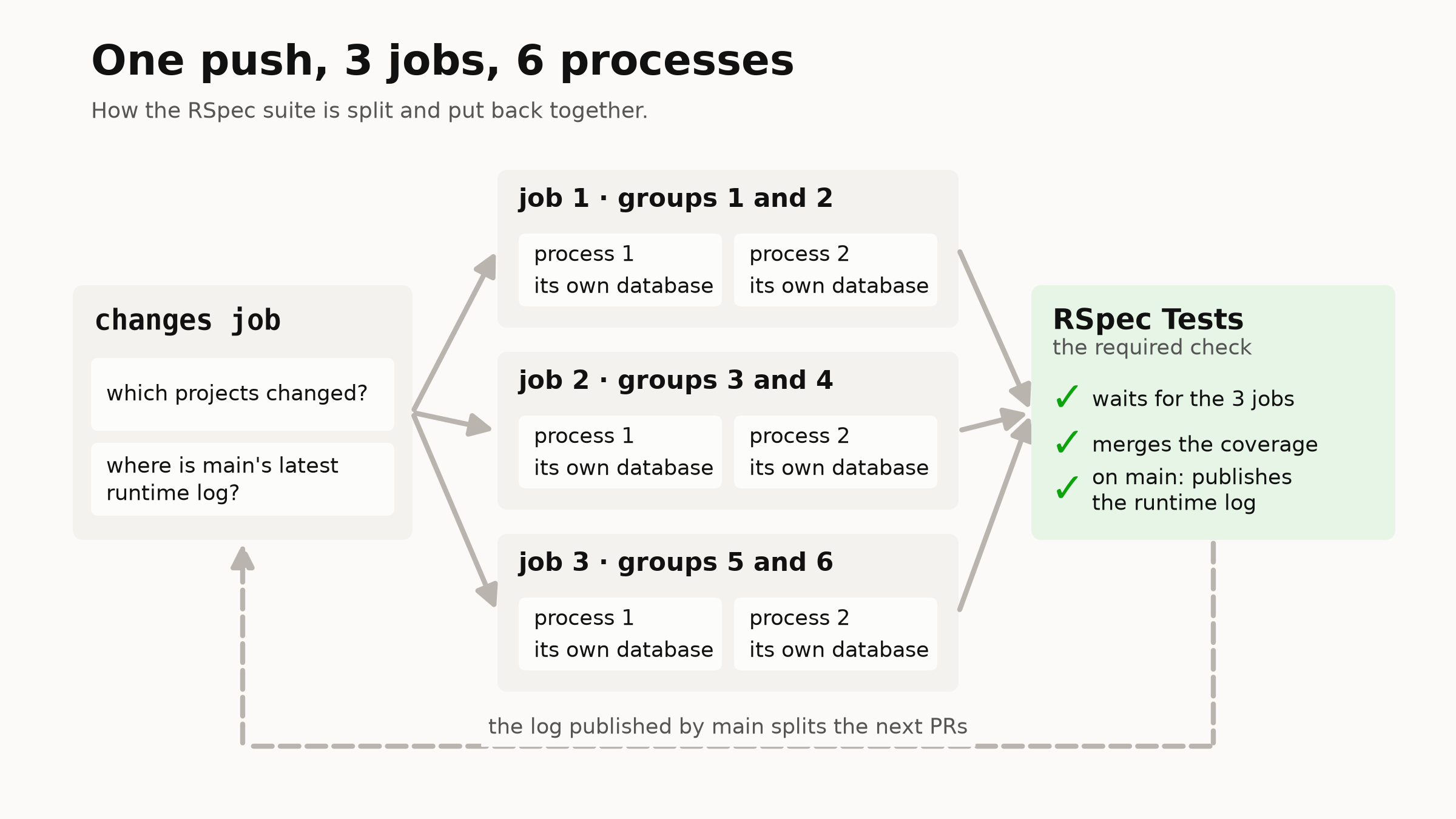
We use parallel_tests. It cuts the suite into 6 groups of files. Each job of the matrix takes 2, one per runner vCPU.
strategy:
  matrix:
    groups: ["1,2", "3,4", "5,6"]
steps:
  - name: Prepare database
    run: |
      bin/rails db:schema:load
      # process 2's database, copied from process 1's
      psql "$POSTGRES_URL" -c "CREATE DATABASE app_test2 TEMPLATE app_test"

  - name: Run RSpec
    run: |
      bundle exec parallel_rspec -n 6 --only-group ${{ matrix.groups }} \
        --group-by ${{ inputs.runtime-log-run && 'runtime' || 'filesize' }} spec
Each process has its own test database: database.yml appends TEST_ENV_NUMBER to its name.
Groups of the same duration
The slowest job sets the wait, so we want the 6 groups to take about as long as each other. parallel_tests can balance them if it has each spec file's duration, in a log. Without a log, it splits by file size, which is less accurate.
We keep that log in an artifact: GitHub Actions lets a run store files (here for 14 days), which another run can then download. Every green run on main publishes its own:
- name: Upload runtime log
  if: github.ref == 'refs/heads/main'
  uses: actions/upload-artifact@v7
  with:
    name: rspec-runtime-log
    path: api/tmp/parallel_runtime_rspec.log
    retention-days: 14
Each job computes the split itself, from the log. For the 3 jobs to land on the same split, they must read the same log. But main publishes a new one on every green run, and the 3 jobs don't necessarily start at the same time: each waits for a free runner. If a main run finishes between two starts, two jobs split with two different logs. Some files then fall into no group that runs, and CI stays green.
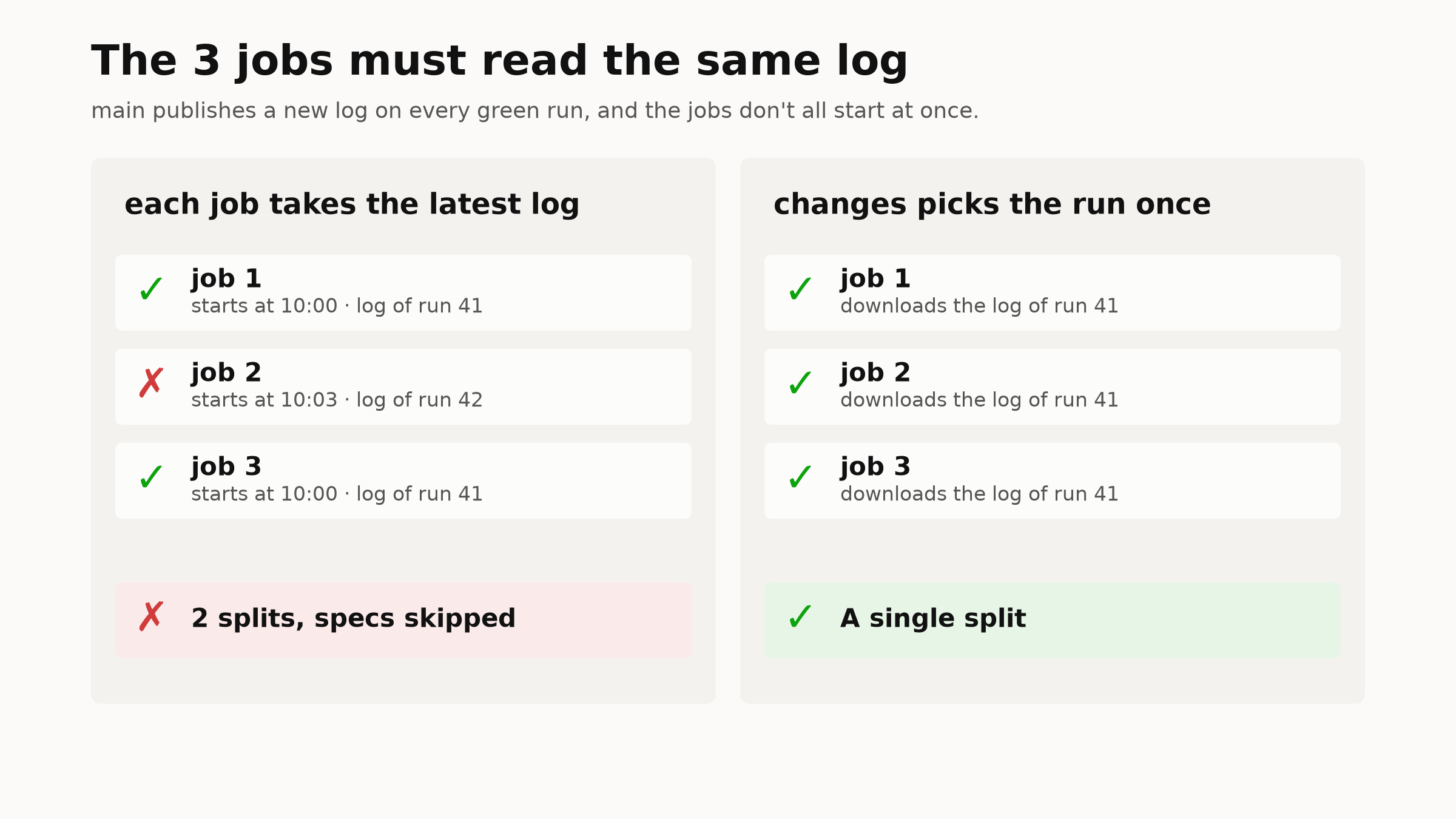
So the changes job, which already runs before the tests, picks the run once, and the 3 jobs download that run's log:
# changes job
- name: Find main's RSpec runtime log
  id: runtime-log
  run: |
    echo "run=$(gh api "repos/$GITHUB_REPOSITORY/actions/artifacts?name=rspec-runtime-log&per_page=100" \
      -q '[.artifacts[] | select(.workflow_run.head_branch == "main" and (.expired | not))] | max_by(.created_at) | .workflow_run.id // empty')" >> "$GITHUB_OUTPUT"

# each of the 3 jobs
- name: Download main's runtime log
  if: ${{ inputs.runtime-log-run }}
  uses: actions/download-artifact@v7
  with:
    name: rspec-runtime-log
    run-id: ${{ inputs.runtime-log-run }}
    github-token: ${{ github.token }}
    path: api/tmp
How many jobs?
GitHub bills each job rounded up to the minute, and each job pays its setup (about 50 s here). We measured 8 configurations, 10 runs each, and kept a simple rule: one more job must save at least 20 s per extra billed minute.
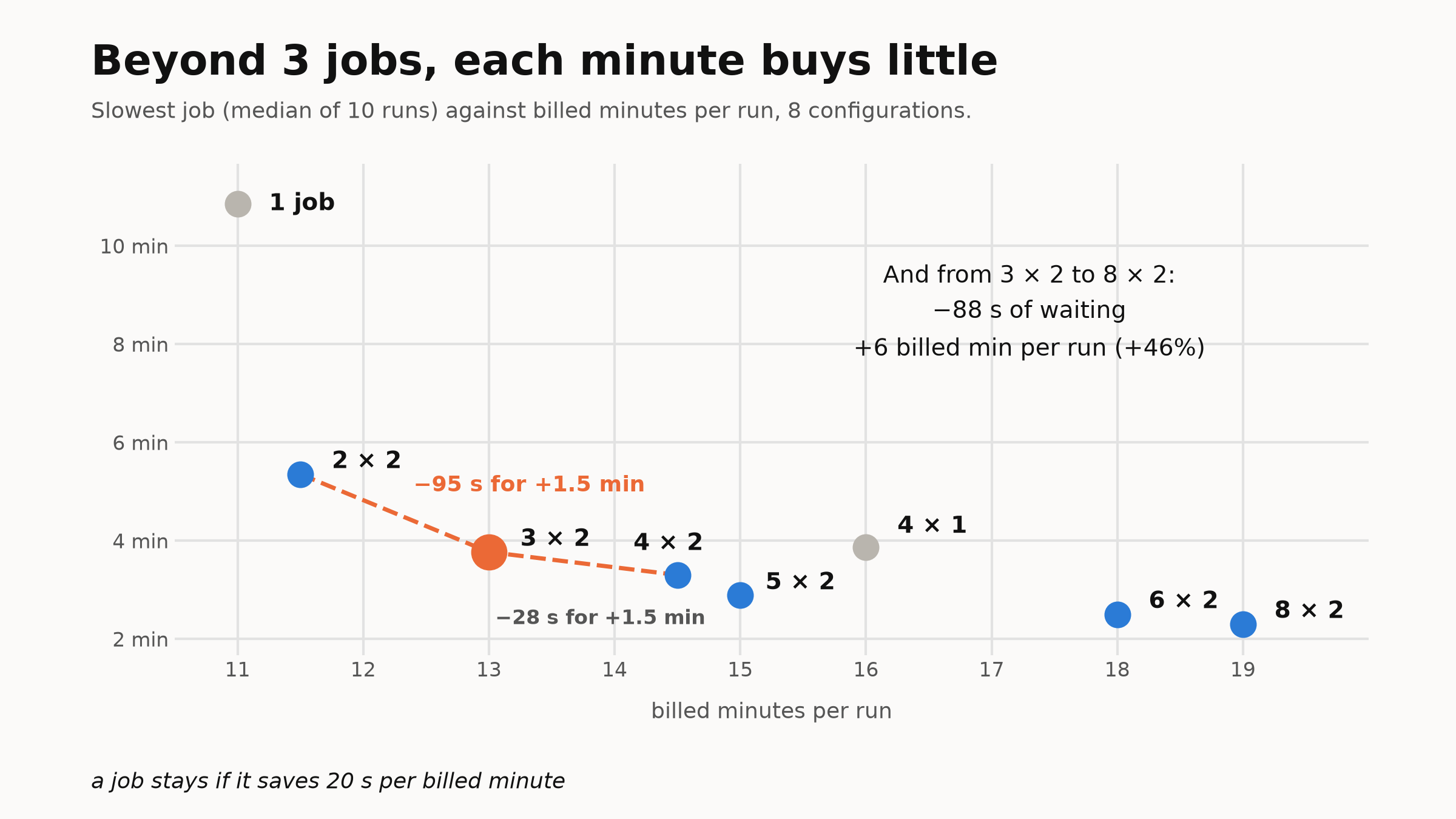
Going from 3 × 2 to 8 × 2 would save 88 s of waiting, for 6 more billed minutes on every run: +46% on the RSpec bill. Beyond 3 jobs, rounding to the minute also comes down to a few seconds: a real 5 × 2 run was billed 18 minutes instead of the expected 15.
And 4 jobs of one process cost more than 3 jobs of 2, and finish later: each runner's second vCPU sits idle.
Overall
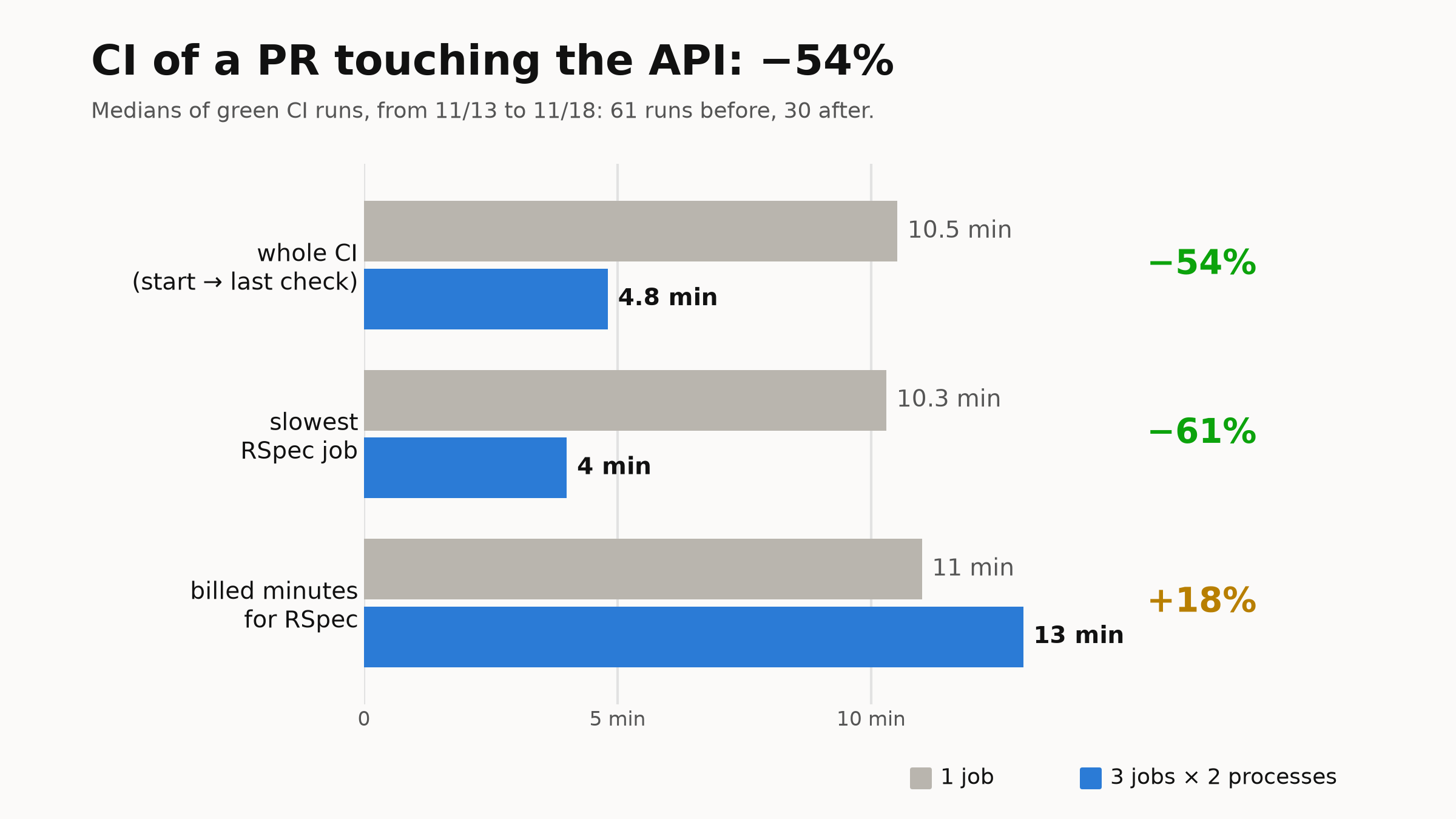
On a PR touching the API, the whole CI goes from 10.5 to 4.8 minutes median (−54%), for 2 more billed minutes per run (+18%). The suite itself still does the same work, spread over 6 processes. For it to do less, the specs themselves have to get lighter: that's the next article.